Saturday, 31 July 2010

Sailboat Landfall in 'Bora Bora - The Beautiful'

For all of you Sailboat 'Adventure of a Lifetime Planners' out there that have still to make the plunge and begin your planning for your sailing oddyssy - still vacillating even - take a look at one of the most beautiful landfalls in the world you could ever hope to make in your voyage. This will spur you on!

Having spent two weeks in Tahiti, then sailing on to Moorea, Huahine, Raiatea, all of which are fabulous destinations to sail into and spend time, Bora Bora is in a class of its own. From the moment you raise the two famous peaks, spy the reef and hear the boom of the surf, the lush greenness and finally the translucence turquoise of the water in behind the reef, you are spellbound.

The following is an extract from my ebook 'Sailing Adventures in Paradise':


Poking his head out of the hatch, the salty blast of breeze slaps her captain in the face. Laden with moisture it fingers his face, threatening rain. Lead like, the southern sky is an endless flat grey expanse from the horizon up. Either she is sailing into a weather system, or it is another local anomaly. Running a printout from the weather fax shows no major system in their slice of the ocean. Remembering a similar situation on the run down to the Tuamotus' when she lost her starboard shroud, her crew take a reef into her mainsail just to be sure. Mid afternoon sees the cloud shredding into blue, and, with the sun streaming through, the breeze frees again to the 'Trades'. Her crew shake out the reef and in no time at all she is barrelling along again in fine style, at her customary seven to eight knots. Her waterline, scrubbed before leaving Raiatea, has the water bubbling gaily along her sleek, fulsome waist and sides - she feels great.

Making their goodbyes earlier in Raiatea, the arrangement is to meet up again in Tonga, if not before. Both ships are taking the same course, visiting Niue on the way, but with vhf having a range of twenty five or so miles only in the other boat, it will be difficult to keep in contact with their friends. Passing out of Raiatea, she had headed around the top end of Taaha Island, and looking in one of the 'Passes' our crew beheld one of the most wicked surfing breaks imaginable. Curling in at the point of the Passe, rising up onto the reef, the glassy black rollers boom onto the jagged coral, snow white spray leaping high. A few surfers are actually riding them, taking their life in hand every time they catch one of these monsters. Our crew could hear the whoop of the occasional surfer brave enough to try and ride it out, surviving.


Twin peaks of Bora Bora 
Her captain, gazing at the sea, is once again struck by the multitude of different moods she parades herself - revealing all, but revealing nothing. Every day is different, from blazing blue through to stone grey, sometimes even almost black - from calm to rough and sometimes tempestuous, and back to calm again - sometimes sparkling and sometimes threatening - constantly changing, so that even a half hour can make a difference. The one constant is constant change. No wonder that artists always struggle in their daubs to capture the true image of the sea. She is so elusive, even in a fractured moment, too much for the artists eye. Capture it on film ok, but transfer that with medium to canvas or paper and something is always missing. The restlessness on a human face can be conveyed in a portrait, but the heaving, ongoing, never stopping restlessness of the ocean is beyond our capabilities. The best the artist can hope for is a fairish representation of this element that covers seventy percent of the planets' surface. That statistic, plus the fact that our bodies are seventy two percent water, gets him wondering if there is any connection between the two, and in the end, we are all mixed in together, as in a giant washing machine, and part of this huge juggernautical whirlpool called life. Whatever it may or may not be, water, in all its forms, fresh or salt, sea or lake, river or pond, has a colossal effect on our lives as joint occupants of this Earth.

Wafting up the companionway, a redolent whiff of fresh baking rouses him from his musing, and his thoughts turn to a more basic requirement - food.

'Insufferable glutton!' she taunts her captain. 'That's all you think about - filling your belly!'

There are few things more pleasurable than demolishing several hot buttered scones in the cockpit of a yacht on a fine breezy tropical afternoon, and washing them down with pure drinking water with a touch of lime, from the watermaker.

On to Bora Bora, our little ship cruising quietly now as the breeze moderates, notices an increasing number of glutinous floating objects gliding by. These are the jellyfish of the round, mushroom shaped, transparent type with four darker rings placed precisely in their centre. By the time our crew notice them they have multiplied to legion proportions and her bow is slicing through them, shoving them aside in their hundreds. They travel like this for some thirty minutes and during this time the animals are so thick that they have a deadening effect on the surface of the water, smoothing it down from a regular light to moderate breeze wavelet surface, to a gently undulating mass of these strange creatures.

How far they stretched away from our little ship on either side, they cannot tell, but taking into account the time it takes for her to sail through them, the shoal must number in the multi millions. Our crew wonder idly if these animals have any natural predator - maybe they are whale fodder, and because there are less whales now, the jellyfish has prospered. With this gummy carpet of living jelly heaving all around them, even though the breeze is still there, a kind of eerie stillness pervades the scene. She is ploughing through them at around five knots, but leaving no trail. Her cutwater shovels them aside and they slither along her sides, the full length of her hull, to immediately close up again as they pass under her stern.


Passe Teavanui
There is no trace of where they have been a few moments before. The phenomenon begs the question, why such a concentration of these animals right here? What are they doing here? Are they going anywhere? Or are they just drifting on the ocean currents of the globe? Are they here in preparation for mating? If so, there is no shortage of choice! Nature takes care of her own, keeping a balance, and she no doubt has them here as part of her master plan. Breaking out the other side, the diminishing numbers are shaken off and she surges forward, and away from the mass concentration. Some several minutes later, she has cleared most of them and they have reduced to the occasional laggard slipping by and into her wake.

The twin peaks of Bora Bora are climbing out of the forward horizon and the island is taking shape exactly as described in the pilot. Part of her captains' mind is always surprised at how the geographical features of a new destination, viewed for the first time, are a faithful replica of a printed or photographic description, as if there is the possibility of there being some change or difference, or that the cartographer got it wrong! And so there is this mild feeling of surprised satisfaction that the real thing matches the representation and it has been chronicled correctly. The leisurely approach of a sailing yacht enhances this feeling and gives our crew the opportunity to study this island jewel closely as they draw nearer. Bora Bora is known as 'The most beautiful', and from this distance it is shaping up to its reputation. James A Michener immortalised it in his 'Return to Paradise' with the following : 'I first saw it from an airplane. On the horizon there was a speck that became a tall, blunt mountain with cliffs dropping sheer into the sea. About the base of the mountain, narrow fingers of land shot out, forming magnificent bays, while about the whole was thrown a coral ring of absolute perfection, dotted with small motus on which palms grew. The lagoon was a crystal blue, the beaches were dazzling white, and ever on the outer reef the spray leapt mountainously into the air.'


Bora Bora lagoon
On this perfect South Seas day, the sun casting its flawless, radiant light into the mountain tops of the island, it is indeed the embodiment of paradise. Blazing white of sand under, the delicate pale aqua of the lagoon is reflected upward onto the underneath of the fluffy white clouds around the twin peaks, creating a unique and dazzling display, floating and turquoise in the skies. The coral reef surrounds Bora Bora like a necklace in that it is almost perfect in its symmetry and equidistant from the main island. Fortunately there is a Passe, the only one, on the western side of the reef. It is named Passe Teavanui and leads into a magnificent deepwater bay right under the splendid, towering twin peaks for which Bora Bora is renowned. Our little ship sails easily through this wide Passe, across the bay and right up to the Bora Bora Yacht Club, nestled in a cove about one and a half kilometres north of the main town, Vaitape. The water off the clubhouse is a dark, still, fifteen fathoms, dotted with vessels of various description and vintage. In addition, there are a number of orange mooring buoys in the bay and, to one of these she heads rather than dropping anchor in this deep water.

'Take the least line of resistance when offered'. She thinks, her captain concurring directly.

She judges it perfectly - no wind here - they hook on, her captain shuts down the engine and she settles to rest in this, another corner of paradise.

If you enjoyed reading this passage, you can read many more similar escapades in my ebook 'Sailing Adventures in Paradise'' downloadable from my website www.sailboat2adventure.com 

Thursday, 22 July 2010

Driving a Sailboat Astern/Reversing Technique for Sailors

Sailboats and yachts are built to go forward on the wind. However, from time to time we need to go astern, so every sailor needs to learn the technique of driving his vessel in reverse and become proficient at it, particularly when crossing stretches of water with a current and also winds. This is one of the most difficult things to achieve in the early days of sailing when there is so much of eveything else to learn. not only do you have to contend with current and wind, but a phenomenon known as prop walk.

When looking forward at the stern of your boat and say the prop spins clockwise (right hand prop), then the action of it through the water will tend to kick the stern to starboard.

When in reverse your prop is rotating anti clockwise, so then its energy will try to kick the stern to port. When you are in forward gear it is never a problem as a minute adjustment on the helm controls it. If the propeller is a left hand prop, then the action is the opposite.

However, in reverse going astern this whole process can be very difficult to manage at the best of times and even more difficult when you are contending with the wind and possibly current as well. Some sailboats are much worse than others! When you are buying yours have the owner or broker drive the boat astern to see how they manage it.

The video below gives you some idea of the problem and how to overcome it. It has been produced by Tom Cunliffe, a well known sailor and instructor of all things sailing.


In my experience, the most simple solution and best way to overcome this problem is to fit a good quality feathering propeller -not to be confused with a folding prop.

A feathering propeller has several major advantages and they are:

The blades follow the flow of water so drag is far less and boat speed increases.

Because the drag is less, improved fuel economy is the result when motoring.

And the real killer is that any good quality feathering prop will give 85% or better driving power when going astern and therefore eliminate prop walk.

This enables you to steer the boat in reverse quite easily even in a strong breeze.

I fitted one to my yacht prior to crossing the Pacific and it was a dream to use when going astern and in addition gave on average 1.5 knots greater boatspeed when under sail. This is a major increase in boatspeed and means an extra thirty to forty nautical miles per twenty four hour period. This is huge when you consider that that extrapolates to four hundred or so nautical miles on a ten day passage, possibly shortening the passage by two to three days.

Video courtesy Tom Cunliffe and Yachting Monthly and images courtesy Google images.

You can read more about fitting and the performance of feathering propellers in my ebook 'Voyage of the Little Ship Tere Moana' downloadable from my website http://www.sailboat2adventure.com

Thursday, 17 June 2010

Sailing Tips: Rounding up and How to Prevent for Sailors

Rounding up is one of the more annoying things to happen when you are sailing into the wind on a gusty day. It slows your boat down and if uncorrected can put your nose right in to the wind and stall the boat. Then you have to bear away and regain boat speed. Not a good look, especially if there are other boats in the vicinity watching!

The following article from http://www.sail-world.com/ explains clearly what to do when it happens and how to avoid by watching your telltales and competent sail trimming:

'Rounding up is caused by many factors. One is too much wind and force aloft which tends to heel the boat over. This reduces the amount of rudder in the water and thus the rudder’s effectiveness. Another factor in rounding up is that the centre of pressure of wind on the sails is too far aft. This then pushes the aft of the boat downwind and thus the front of the boat upwind.

Our SailTrim clinic discussed this topic and so what we wanted to do was test it out for sure. So last weekend we took out a friend’s Beneteau 373 to test out an anti-round up theory. Read on to find out the results of our experiment:

1. First though, we must first understand wind shear.

The phenomenon of wind shear is pretty easy. Wind moves faster at the top of the mast than it does at water level because the stationary water by friction, slows down the wind the closer it gets to the water. So, if you could see wind you can visualise in your minds eye the water at sea level dragging the wind a little at the surface.

2. Secondly, consider the concept of true wind vs apparent wind:

This is best understood by imagining driving your car in a cross wind with your hand out the window of the car. At stand still you would feel the wind coming from the side of the car. The faster you go, the more you feel the wind coming from the front of the car. But when a gust of wind comes (which is just an increase in true wind speed) then you would feel the wind shift back more to the side.

When relating this to a sailboat, if your boat was standing still, the wind at the top of the mast would be the same apparent direction as at the cockpit level albeit, faster (from the wind shear phenomenon). However as your boat picks up in speed the apparent wind moves forward BUT because of wind shear it shifts forward less at the top of the mast, ie., at the top of the mast the wind tends more to the direction of true wind direction because the true wind speed is higher.

Thus at the top of the mast the true wind is more aft than the apparent wind.

So – the fact is: at the top of the mast the wind is higher in speed and more aft than at cockpit level.

Figure A and B show the boat speed, true wind and apparent wind vectors for cockpit level and top of the mast. Obviously in both cases, the boat speed vector must be the same. The true wind vector is obviously the same direction but due to wind shear it is longer (faster) at the top of the mast. This results then in the apparent wind direction being more aft, in this case from 135 deg to 125 deg.

3. Third, there's wind shear and apparent wind phenomenon:

You should understand that if a sail is sheeted in too tight it creates more heel. This then is exactly what is happening at the top of the mast. Even though at the bottom of the sail you may have perfectly trimmed the sail, the top of the sail is sheeted in too tight against higher wind speed. No wonder you’re getting excessive heeling. And excessive heeling creates roundups.

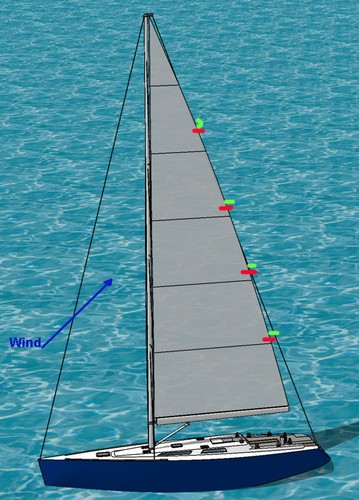
This is now quite a revelation! It means that the top of the main needs to be “out” further than the bottom of the sail for it to operate efficiently. This is usually indicated by the top telltale. Often the leeward telltale will be stalling at the top of the sail. Especially in high wind because of the phenomena above.

So, the top of the mainsail needs to go further out so that the starboard telltale can fly smoothly. Hence the top of the mainsail needs to be let out further so that the leeward telltale can fly smoothly.

This is commonly referred to as twisting the sail out at the top. Except people believe you are just spilling out (wasting) the wind at the top. Not quite so now, as you’ve just learned. Twisting out the top of the sail is letting the top of the sail fly according to the direction of wind it is feeling.

In the illustration, you can see the top telltale on the downwind side is fluttering. If you let out the main at the top, the wind can reattach to the sail on the leeward side and the telltale will fly smoothly reducing the force aloft.

Understanding all the above. How do we stop rounding up?

Option one: Obviously the first and safe option in higher winds is to reef the sail.

Option two: Let out the traveler which is what most people do when hit by a gust. Just so long as you realize what you’ve done is not twisted the top of the sail out – all you’ve done is let out the mainsail from top to bottom and thus depower the mainsail. This reduces the force aloft and thus the heel. It also moves the centre of effort of wind on the sails forward which reduces tendency to round up. The trouble is that you spend all day fighting gusts with still quite a few involuntary round-ups.

Option three: Let out on the mainsheet. Here again you’ve depowered the entire mainsail to handle the gust. Still, it works.

Option four: Permanently reduce the force aloft by letting out further on the mainsail and tightening up on the traveler. The trick here is to bring the mainsail bottom back in again using the traveler. Yes, bring the traveler to windward up past the center point. Most sailors are reluctant to do this because they’ve been taught that it detaches the wind on the leeward side. But not when you’ve let out the mainsheet. In effect, by letting out on the mainsheet, you’ve allowed the boom to rise up and the leech of the sail to slacken. This creates the desired twist at the top and allows the top of the sail to fly according to its apparent direction. At the same time, the bottom of the sail can fly according to its apparent direction.

By trimming the traveler and mainsheet together you can manage the twist at the top of the sail as desired yet still keep power on the bottom of the mainsail. Keeping power on the bottom of the mainsail keeps your speed up which also increases the effectiveness of the rudder. Increasing the effectiveness of the rudder means it can hold more against any turning effect created by the shifting of center of pressure backwards. Wow – see how it is all connected?

What happened on our 15 knot gusty sailing day? Well, not one round up.

So to summarize, the sailing lesson here is when in higher winds bring the traveler up and sheet out the main. You’ll also need to release the boom vang a little. Letting the boom vang out allows the boom to rise which loosens the leech (trailing edge) of the sail and allows the top part to “twist out”. '

Article courtesy Sail-World and Grant Headifen, images courtesy Sail-World

You can read much more about sail trimming and techniques in my ebook 'Voyage of the Little Ship Tere Moana' downloadable to your PC, iphone or ebook reader, from my website http://www.sailboat2adventure.com

Thursday, 10 June 2010

World Oceans Day 2010 Recognised by Sailors

For cruising sailors pollution of our oceans is a major concern. There is nothing more objectionable when sailing in pristine waters to then come across some discarded flotsam disposed of irrresponsibly - as humans we leave a trail wherever we go! I would trust that these days all yachties keep all trash on board to dispose of correctly at the next port. This way we can collectively make our contribution toward keeping our oceans clean.

The more worrying occurences are the major pollution events such as the current Deepwater oil spillage off the Louisiana coast - this is ocean pollution on a massive scale and even after it is finally plugged the ongoing effects from it will be long term.

World Oceans Day is now officially recognised by the UN and celebrated annually on June o8.

The following is an extract from http://www.sail-world.com/ cruising blog:

'World Oceans Day' .
June 8th is World Oceans Day, and never were our oceans more in need of a friend.

With discarded plastic bags killing thousands of precious sea animals, with the world's fish stocks at record lows and the oil well damage on the shorelines of the Indian Ocean, Canada's Pacific coastline and now the Gulf of Mexico, the world that the sailor loves to inhabit is under threat like never before.

Go to the World Oceans Day website to see how you can be involved!

About World Oceans Day:

As a result of a United Nations General Assembly resolution passed in December 2008, World Oceans Day is now officially recognized by the UN as June 8th each year.

The concept for a “World Ocean Day” was first proposed in 1992 by the Government of Canada at the Earth Summit in Rio de Janeiro, and it had been unofficially celebrated every year since then. Since 2002, The Ocean Project and the World Ocean Network have helped to promote and coordinate World Oceans Day events worldwide. We help coordinate events and activities with aquariums, zoos, museums, conservation organizations, universities, schools, and businesses. Each year an increasing number of countries and organizations have been marking June 8th as an opportunity to celebrate our world ocean and our personal connection to the sea.

Together, we also developed and widely circulated a petition to the United Nations urging them to officially recognize World Oceans Day. With help from our Partner organizations, tens of thousands of people from all parts of the world signed online or paper copies of the petition. Congratulations to all for helping to make this happen!

Designation of World Oceans Day provides an important boost to those organizations and individuals who have been deeply committed to ocean conservation. Official UN designation is another important step toward improving the health of our world's ocean.

Now we need to capitalize on this fresh momentum! We hope you will be involved in planning or participating in a World Oceans Day celebration near you!

Extract courtesy Sail-world, images courtesy google.

We can all do our bit by acting responsibly when at sea and getting involved with various anti pollution programmes when on land. The long term survival of the marine environment is in the interest of us all as humans. Remember, the oceans will survive without us but we will not survive without the oceans.

You can read more about responsible habits at sea in my ebook 'Voyage of the Little Ship Tere Moana' downloadable from my website http://www.sailboat2adventure.com